

Regional trucking is known for its promised home time but very few understand how to define it properly. This is why new drivers think that regional roles are the best place to start their trucking career. They think that shorter distances and set paths will lead directly to a better way of living. This assumption is found to be incorrect in many cases. Real home time is not a by-product of life in regional trucking; it is an end product achieved through a series of deliberate decisions to schedule, protect, and reinforce the provisions of home time in regional trucking and ensure the divergence in operating decisions.
This distinction is critical for understanding real truck driver home time rather than advertised availability.
Regional schedules have a kind of dual nature in the transportation market. They are halfway between local driving jobs, which often provide daily home time but high intensity, and long-haul positions, which give long breaks at the expense of prolonged absence. Because of this dual character, regional routes can either be the tool that allows drivers to lead a sustainable lifestyle or they can replicate the stress of reefer work with very few measurable changes.
This duality is exactly why regional schedule planning plays such a decisive role in long-term outcomes.
It is not the geographic location that is determinant for the success of the schedule. The key factor is the design of the schedule.
Well-designed driver schedules are the foundation of sustainable trucking home time.
The Misunderstanding about Home Time
Many trucking company schedules have a checkbox approach to home time instead of a lived experience. Phrases such as “weekly home time” or “frequent resets” may sound promising, but they hide the main points. Does a home stay start early enough to actually have a rest? Is it protected from the changes that come out of the blue? Or is it the case of being flexible whenever the shipping pressure increases?
This is where quality home time and nominal home time begin to diverge.
Truck driver home time is usually the result of diminutive compromises that are made many times. A late delivery, an extra stop, a final “quick load” before taking off to home. Every decision seems rational by itself. But together, they build up and the driving schedule is such that the drivers are technically home but they are never fully recovered from work.
Over time, these patterns directly affect driver work-life balance.
Being close is not enough for the real home time. You need predictability, windows for recovery, and distinct lines drawn between work and personal time.
This is the core principle behind how to schedule home time correctly.
The Master Scheduling Reality of Regional Drivers
Being completely honest, the regional schedules or those routes that are shorter in distance are often perceived as the easiest form of transportation. There is just the thing that fewer consecutive days at home is a myth. Sometimes they involve much tight delivery windows, more stops, and greater variances in the schedule. That is to say, if not properly planned, this kind of pressure diverts more time than freed up.
In contrast to over-the-road roles, regional drivers typically return home weekly or several times per week due to the nature of regional trucking routes. Drive My Way
Many regional trucking routes quietly carry the same pressure as long-haul work.
The common mistake that entails the structure of treating home time as an outcome rather than a restriction. Route planners that set the routes first and add the home time in later make home time prone to disruption. Freight volumes go up, schedules miss the mark, and drivers pay the toll.
This approach weakens both driver retention and operational stability.
The inversion of this rule is what gives effective regional route planning the upper hand. The home time is the one that is set first and the routes are then arranged around it.
This method represents best practice in planning regional routes.
Home Time That Is Claimed vs Home Time That Is Quality

| Schedule Element | Poor Regional Scheduling | Home-Time-Focused Scheduling |
| End-of-week timing | Late-night arrivals before reset | Early or mid-day return home |
| Route sequencing | Final stop far from home base | Routes funnel toward home |
| Dispatch flexibility | Home time treated as adjustable | Home time treated as fixed |
| Buffer time | No slack for delays | Built-in buffer before home |
| Driver recovery | Technically compliant only | Designed for real recovery |
Home time is not created all the same. Quality home time leaves drivers to physically and mentally detach from work. It gives them the time to listen to their own thoughts without interruption, spend more time with their families, and, in that way, recover mentally. Claimed home time, on the other hand, may include a short stop overnight with little chance to recuperate.
True quality home time is measured by recovery, not by mileage.
Most of the CDL driver schedules are those that deliver home time that is in line with the policy language but it doesn’t actually happen as it ought to be. Drivers usually get home at night, spend one or two days recovering, and take off without being fully fit. The repeating of this scenario for months and weeks results in the degradation of the driver lifestyle and the increase of tiredness.
This cycle explains why driver retention often declines even in regional fleets.
Quality home time planning is carried out only when one agrees to the fact that recovery is a positive process. It requires timeframes, predictability, and protections.
These protections define meaningful regional driver benefits.
The Impact of the Trucking Schedule Planning on Driver Lifestyle
Driver’s schedules dictate their daily life largely more than the mileage and pay. When the patterns of the schedules are known the drivers can regulate their sleep, meals, exercise, and personal commitments. When the schedules are constantly different, stress is accumulated anyway, regardless of the compensation.
This directly shapes driver lifestyle and long-term satisfaction.
Regional routes that the drivers maximize home time with tend to share some common features:
- They are consistent over the week
- They minimize last-minute changes
- They respect end-of-week boundaries
Drivers know when they will return home and can plan their lives accordingly.
These practices are central to regional schedule planning.
That same consistency is what serves as the groundwork for better work-life balance and long-term satisfaction of the drivers.
Main Objective: Planning Regional Routes for Home Time
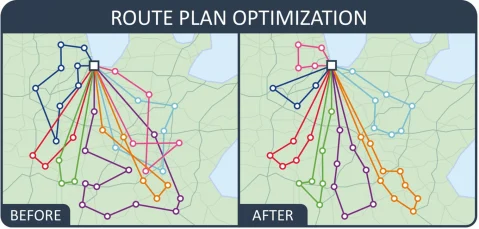
Planning regional routes has, quite often, been seen as a logistics optimization problem where the focus is on plenty of miles, fuel, and delivery windows. While it is organic, the branches of a tree have to be pruned sometimes to be really healthy. Sometimes what looks to be the optimal route on paper causes far more problems in the long run, for example, finding it distant from the driver’s base or finishing up with difficult deliveries at the end of the week.
This is a common flaw in regional trucking routes.
Home time regional route optimization is achieved through backward thinking. Instead of starting with freight availability, the first step in planning should be the desirable home arrival window. Only then should the routes be set in the way they will be driving back at the end of their cycle.
This logic is essential when planning regional routes for stability.
This way, it is possible to have fewer empty miles due to the dead head, fewer last-minute changes, and a more reliable schedule.
The Buried Consequence of Route Sequencing
The sequencing of routes is crucial but it is often neglected in terms of the outcome. Two routes that are equal in mileage and stops can give such different results just because of their order. Prompt sequencing would often ensure that drivers would finish the last stop much closer to their base and keep the home time amount intact without losing any productivity.
Sequencing decisions strongly influence trucking home time.
If the planners are conscious of the sequencing and the distance, the result of home time being much more outsized is a reality.
Discipline in Dispatching and Schedule Integrity
No matter how perfectly designed schedules are, they are not going to work without dispatching discipline. Schedule-breaking dispatch decisions can, in moments, destroy weeks of thoughtful planning.
Dispatch is pivotal in whether home time policies succeed or fall down. Home time loses its meaning when it is viewed as malleable. It is when the home time is kept as the fixed one, the trust is built.
Trust is a key driver of driver retention.
The operational rules are the key in protecting home time:
- No last-minute loads before scheduled return
- No surprise reassignment
- Early communication when disruptions happen
| Scheduling Practice | Short-Term Effect | Long-Term Impact |
| Unpredictable return times | Higher weekly stress | Faster burnout |
| Frequent last-minute changes | Dispatch friction | Higher turnover |
| Consistent weekly patterns | Better planning | Strong driver retention |
| Protected home time windows | Improved recovery | Longer career longevity |
| Stable regional routes | Lower fatigue | Higher loyalty |
Quality Beats Frequency
Home time is often judged by the amount of time the drivers are at home. However, what matters more in practice is the consistency of home time than the frequency of home time. A straightforward, regular weekly home that is often broken is preferable, in particular, to an unpredictable long break.
This distinction defines sustainable regional driver benefits.
Drivers benefit from regular schedules as it empowers them to pace themselves. As they encounter exhaustion drivers will know it is time for the rest period. The more these drivers are predictable the safer they become and they will be less likely to feel burn out.
Rest and Not Just Legal Compliance Scheduling
The legal requirements say that drivers need to have certain hours but that won’t ensure they will be back in good form at all. The rate of driver tiredness marks the difference between regulations that are simply met and those that are truly effective.
Properly run home time scheduling takes account of the struggles that a human has to endure. It means refraining from consolidating deliveries before rest periods, and route timing that is away from tight. Drivers who get to rest and recover well come back to work with higher resilience, and focus.
This approach strengthens both performance and driver retention.
It has a ripple effect of decreasing errors, incidents, and turnover which in turn enhances the overall operational efficiency.
Driver Trust as an Outcome of the Home Time

The driver is less likely to lose the job if they can trust the schedule. It is the firms that are able to list their drivers as requested, and that regardless of policy changes, maintain the predictability of their schedules, that drivers will value the company as a good place of work.
Trust is built when how to schedule home time becomes a core operational principle.
It is the trucking operators who change the face of the industry by learning to plan regional schedules for genuine home time. They reap the rewards of greater stability, safety, and performance. By the way, ensuring jobs are joined with well-designed schedules and they will be good for the drivers’ full career and way of living.